



“Have you ever fed a baby squirrel?”
That was the email I received from Hope Kosch-Davison, Founder of Wild Baby Rescue, when I’d reached out to see if she needed any volunteers on site.
“I’ve got 37 baby squirrels right now,” her e-mail read….
A few days later I drove out to the northwestern edge of New Jersey to spend the day with Hope and learn all about caring for the injured animals on her farm.


Hope’s passion for animals is almost implausible. As I worked alongside her and her intern Cheylynn, I quickly realized how rigorous their daily schedule was. Each of the almost 60 squirrels had to be hand-fed with droppers and cleaned. Feedings took place at least three times a day.


Special food for the other animals had to be prepared and then fed to the adult squirrels, bats, opossum and other animals.
Mixed in with all this was constant cleaning of the cages, containers, pens and incubators. And laundry… never-ending laundry to ensure clean towels, blankets and other items were readily available.
Throughout the day the phone often rang with people looking for advice and guidance:
“There’s a fox in our yard who’s lost most of his hair on his back and his tail
– what does that mean?”,
“My cat attacked and brought home a wild baby rabbit – what can I do?” ,
“I found an injured opossum on the side of the road, can you help?”
These were just some of the calls that came in while I fed the squirrels.


Hope also works closely with a local college to mentor wildlife management students in their education, working with the professor on final student projects. While I was volunteering, one of the students came by to meet with Hope and start her project.


Orphans like the tiny squirrels I worked with, start their stay in warm indoor incubators then move out to outdoor sheltered cages once they are big enough. That’s where they get used to the sound of the rain and sunrise/sunset. They learn to live on swaying branches, to build homes, and to forage for food. This way they learn all the necessary skills to survive in the wild.
It was interesting to learn the animals are released in the general area they were found, unless there is some specific reason not to do so. I also learned that some people can request their animals back (depending on the animal)! Meaning, the animal is released directly back on their property where it was found. In those cases, the families must agree to help transition the animal back the wild.


“Baby squirrels have always been my favorite,” Hope said as she was guiding me on baby squirrel feeding. Her father was one of the linemen for PSE&G when she was a little girl. He often worked to repair the electrical boxes on telephone poles. Back then, the boxes were wooden, instead of the metal ones you see today, and squirrels often chewed their way into the boxes to make their nests in the warmth. The workers were told to get rid of the squirrel families because they could short out the boxes and cause electrical outages. Hope’s father did not want to just toss them into the woods and so he started taking them home in his pockets, where he’d have Hope help care for them until he could relocate them. Fellow linemen started giving Hope’s father squirrels they came across too, and so was born the first iteration of a wildlife rescue program. Those many happy memories working alongside her father and caring for the squirrels left a special imprint on Hope’s heart. It began her lifelong journey as an animal caretaker.


Rabbits, squirrels, raccoons, foxes, fawns, chipmunks, opossums, groundhogs, bats and even coyotes have been helped by Hope and her staff. The center is not licensed to care for bear or bobcats, but Hope will always put a caller in touch with the right center to help.
Hope is also passionate about educating the public on orphaned or injured animals. I learned that many well-intentioned people come across an animal and think it is orphaned or hurt, but it may not be. Unnecessarily removing an animal from its environment – especially a baby – can often cause more harm than simply leaving it, so it is important to recognize signs of distress. For example, mother deer often leave their fawns alone while they go foraging for food. Baby birds often spend a few days in the brush when first learning how to fly.


WBR’s “To the Rescue” page on the website has information, by species, on what to do should you encounter a wild animal you think may need assistance. Hope said you should always call a wildlife center for advice before you move or touch an injured wild animal.
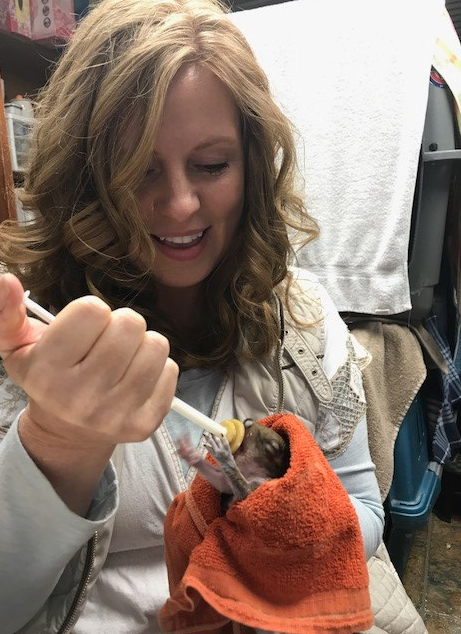

It took me several tries before I mastered reaching into the incubator and picking one up.
They’re squiggly and want to climb all over you, so there’s a trick to wrapping them gently in a warm towel and holding them correctly. Once you get them to take the dropper of warm milk, they calm right down and relax, often reaching their tiny hands out to hold onto the dropper like a bottle. They make the cutest happy grunts and sounds while they eat and sometimes they fall asleep in your arms, all cozy and happy.


Hope and her team keep the baby squirrels divided up in various incubators according to things like age and location they were found, so the incubators have town names like “Morristown” on them. She also is very cautious about counting the squirrels in each incubator to ensure everyone is fed and in the right spot.
I spent several hours feeding the babies that day, which I loved. I also helped Hope and Cheylynn care for the goats, chickens and opossums, and I watched Cheylynn feed the adult male bat a breakfast of live meal worms….


Everyone at the Wild Baby Rescue Center is a non-paid volunteer, many are interns and students working towards licensing.
Outside volunteers are always welcome to do things from helping feed the animals (you need to be 18 to feed the squirrels), to building cages, to working on the farm, to knitting bunny nests and more.
Hope runs the center out of the bottom floor of her home and on her family’s farm property…. For her and her family, this is a life passion.
If you’d like to learn more information about Wild Baby Rescue, make a donation, or volunteer to help Hope and her team, please visit their website at: http://wildbabyrescue.org/
Thank you for joining me on this week’s journey! See you next week!
XO XO – Penelope


