Some organizations are born from vision. Others are born from heartbreak and the determination to turn grief into action.
Auntie Advocate, based in Norfolk, Virginia, is one of those organizations.
Founded by LaTonya Snow, Auntie Advocate exists to support families affected by life crises — especially those impacted by gun violence — by building bridges to resources, community support, and hope.
LaTonya’s journey into nonprofit work began with unimaginable loss. Her nephew, Xzavier Hill, was shot and killed by a Virginia State Police officer.
Before his death, Xzavier was already an advocate in his own right — eager to serve his community and participate in protests that called for change.
After his passing, grief turned into purpose.
“When he got killed, I had to start working,” LaTonya shared. “We were protesting, we were grieving, and I was asking myself how I could make a difference and support others.”
At first, she hesitated like many who feel the pull to serve but question whether they are ready.
But after beginning studies in social services and receiving encouragement from her mentor, LaTonya found the motivation to launch outreach programs throughout the Norfolk area.
Today, Auntie Advocate provides meaningful, hands-on support to families navigating crisis.
Their outreach includes:
• Mental health session outreach programs • Free hygiene product distribution for individuals and families in need • Emergency fundraising support on a case-by-case basis • Community-based programs • Seasonal initiatives like the Summer Snacks event, helping ensure children have access to nourishment and support during school breaks
What struck me most about Auntie Advocate is how deeply personal this work is. It’s not just about providing resources. It’s about standing beside families in moments when life feels overwhelming.
Experiences like this remind me that many small nonprofits begin not with large budgets or formal plans, but with heart, resilience, and a deep connection to the community they serve.
We spent the day creating chalk messages of hope and love across the Norfolk, VA area while doing a bit of public fundraising
As I reflect on my 52 Weeks of Charity journey, organizations like Auntie Advocate stand out as powerful reminders that advocacy often begins with one person deciding that grief will not have the final word.
If you are local to Norfolk, Virginia, or looking for ways to support grassroots organizations making a real difference, Auntie Advocate is one worth knowing about.
Because sometimes the strongest bridges are built by those who understand exactly why they are needed.
As the global climate crisis intensifies, urban areas are increasingly becoming the focal points for innovative solutions that address environmental challenges. In the heart of New York City, Earth Celebrations stands out as a beacon of hope, leveraging the power of art to promote sustainability, community engagement, and climate solutions. This organization has been at the forefront of creative initiatives that not only raise awareness about environmental issues but also actively contribute to building a more sustainable and resilient urban environment.
Art as a Catalyst for Change:
Earth Celebrations recognizes the unique ability of art to transcend boundaries and communicate complex issues in a way that resonates with diverse audiences. By harnessing the creative energies of artists, the organization aims to inspire action and foster a sense of shared responsibility for the environment. Through a variety of artistic mediums such as public art installations, performances, and community events, Earth Celebrations seeks to engage the public in a dialogue about the urgent need for climate solutions.
Community Involvement and Collaboration:
One of Earth Celebrations’ key strengths lies in its emphasis on community involvement. The organization works closely with local communities, artists, environmentalists, and policymakers to create projects that are not only visually stunning but also rooted in the specific needs and concerns of the neighborhoods they serve. By fostering collaboration, Earth Celebrations encourages a sense of ownership among community members, empowering them to actively participate in the development and implementation of climate solutions.
Ecological City: Procession for Climate Solutions:
Earth Celebrations has spearheaded numerous projects that showcase the intersection of art and environmental activism. One noteworthy initiative is the “Ecological City: Procession for Climate Solutions” event, an annual procession through the Lower East Side of Manhattan, along the waterfront. This vibrant parade brings together artists, activists, and community members to celebrate the neighborhood’s ecological achievements and advocate for sustainable practices. The event serves as a platform for showcasing local initiatives, such as community gardens, renewable energy projects, and waste reduction programs.
This year the theatrical pageant/procession included 21 sustainability site performance celebrating the initiatives that focused on solutions to mitigate impacts of flooding and sea-level rise, decrease waste, and improve water quality and conservation.
9 months of educational research, design and planning sessions engaged residents, schools and organizations to collaborate with Earth Celebrations’ artists-in-residence and environmental experts to explore neighborhood sites, learn about climate solution initiatives including green infrastructure design to mitigate flooding, pollution run-off and reduce carbon and global warming and develop visual art and performance works.
The artistic works created through the months of creative collaboration and partnership building workshops are presented in the Ecological City Procession for Climate Solutions in May. The theatrical pageant features a procession of spectacular visual art, giant puppets and costumes with 21 site performances of dance, music, theater and poetry, exploring climate challenges and solutions throughout the community gardens, neighborhood and East River Park waterfront.
Green Infrastructure Advocacy:
In addition to its artistic endeavors, Earth Celebrations actively promotes the integration of green infrastructure in urban planning. Recognizing the importance of sustainable urban design, the organization advocates for the implementation of green roofs, rooftop bee farming, vertical farming, solar gazebos, pollinator gardens, community gardens, and other nature-based solutions to mitigate the impacts of climate change. By incorporating these elements into the urban fabric, Earth Celebrations aims to enhance resilience, reduce the urban heat island effect, and improve overall environmental quality.
Education and Outreach:
Earth Celebrations recognizes that meaningful change begins with education. The organization conducts workshops, lectures, and educational programs to inform the public about the interconnectedness of art, community, and the environment. By fostering a deeper understanding of environmental issues, Earth Celebrations empowers individuals to make informed choices and actively contribute to sustainable practices in their daily lives.
Volunteering:
I volunteered with teams of volunteers and artists in creating some of the costumes that would be used in the procession in May. Artists using textile as materials and metaphor to explore the relationship between textiles, community, and sustainability.
For these particular volunteer shifts our teams worked with artist Yohanna M Roa, a visual artist, curator and art historian with a feminist-decentralized approach to her art. Our goal was to create a series of nature-inspired outfits from recycled materials and other objects, which would be worn in the parade. We spent the time sewing, gluing and designing. It was exciting to see her vision come to life!
Many of the volunteers traveled far distances to participate in the events and there was continuous lively discussion around textile works as a vehicle for social commentary and memory, and how textile art (sewing, knitting, embroidery, etc.) traditionally has been associated with domesticity and femininity and thus was not as valued or accepted as a production of knowledge. Yet around the world and throughout history, sewing, quilting, and embroidery have been outlets for women to use their creativity and create social/political commentary in a socially-acceptable way. We also discussed the role textile art played in American history.
It was an exciting and inspiring volunteer opportunity!
Conclusion:
Earth Celebrations in NYC exemplifies the transformative power of art in driving climate solutions in urban areas. By blending creativity with community engagement and advocating for green infrastructure, the organization serves as a model for how the arts can inspire positive change. As cities grapple with the challenges of climate change, Earth Celebrations stands as a testament to the potential of art to catalyze meaningful environmental action and create a more sustainable and resilient future.
A park clean-up unveils the values, behaviors, and potential of a community
Volunteering at a local park provides a unique opportunity to see a community from a more intimate point of view. A park’s overall design, the activities offered, the special events that take place, the level of involvement by the public in its design and upkeep… these characteristics point towards the social health of a community and reveals its values and behaviors.
I volunteered to take part in a Saturday clean-up at Tompkins Square Park, a 10.5 acre park in the Alphabet City area of the Lower East Side of Manhattan. I was supporting the Friends of Tompkins Square Park – a hyper-local community organization dedicated to enhancing the beauty, health, and safety of the park.
Formed a few decades ago, the group has stepped up their involvement since the COVID pandemic because NYC Parks and Recreation has faced maintenance staff shortages. The residents around the park noticed the park was falling into disrepair and saw an uptick in drug use and homelessness. Friends of Tompkins Square Park increased its involvement and oversight of the park to address these issues and provide a safe, healthy greenspace.
My responsibility for the shift that Saturday was to pick up trash anywhere on the park grounds (such as in the various flower beds and playgrounds). Other groups of volunteers helped plant flowers and mulch around the trees.
The Park as a Reflection of Community:
Examining a park’s design reveals what’s important to a community’s sense of identity – their habits, their community values, and their social structure. It also provides a peek into the future they wish to build together.
If you think about a local park near you – what could its design reveal about your community and its values? For example – How does the design impact who uses the park? Is it designed for diversity of use? Is it inclusive so all people have access to its benefits? How do people gather and interact there? What types of events are held there? How easy is it to get to and use the park?
Tompkins Square Park has a central green lawn area surrounded by winding paths lined with long benches under sun-dappled canopies of a wide variety of trees. The park includes a dog run, 3 children’s playgrounds, chess tables, ping pong tables, a handball court, and a bicycle/skateboard area. Various flower beds provide an oasis of color.
On this Saturday, there was a children’s educational program underway – one of many workshops and events that were scheduled in the park throughout the year, including a weekly greenmarket and live music shows, among many other activities.
Tompkins Square is designed for family and individual use across a wide variety of preferred activities. It is designed as a central hub for community interaction and for use as part of a healthy lifestyle. It reflects these values of the local community and is a vibrant, healthy, well-maintained green space.
Parks Reflect Current Societal Values and Needs:
During my volunteer shift I learned about the rich history of the park and could see how the design of the park evolved based on the needs and values of the surrounding community.
For example:
In the late 1840s, as over 600,000 immigrants and their families came to live in NYC, the wealthy single-family homes around and near Tompkins Square Park were replaced and/or repurposed into multiple subdivided tenement apartments to house an influx of poor immigrants.
Example of tenements Lower East Side (source: licensing purchased from Alamy; image ID CPJ3J3)
The mostly Irish immigrants at that time were typically young, single, second-class citizens with limited education. They met, married and built families in the Lower East Side and typically worked on the nearby shipbuilding docks.
Densely packed into overcrowded apartments (it was not unusual for up to 5 families – about 20 people – to share one room that measured 12 ft x 12 ft) that lacked light, ventilation, plumbing and sanitation, this hard-working community used the park as a way to have some privacy from family and access a bit of open air. It was also an extension of their homes – livestock such as pigs roamed freely.
Churches popped up around and near the park and soup kitchens set up stations in the park to help feed the poor masses.
Drawing of Tompkins Square Park in 1891 (source: Harper’s Weekly)
Only a few decades later the neighborhood would change drastically, and the park would change too. At the end of the 1800’s, there was a huge influx of German immigrants moving into the neighborhood. Coming mostly as families, they tended to have had some schooling and brought with them their culture, including a long history of the master-journeyman trades relationship (guilds). They brought different skill sets from earlier immigrants and had different ideas about how they wanted their neighborhood to function.
Slaughterhouses, factories, beer gardens, and markets opened. Instead of working at the docks, the community was full of tailors, bakers, cabinet makers and other trades, changing the experience of daily life. These families wanted the park to reflect their values and desired experiences. They formed a community association and petitioned the City. The newly established Department of Parks (1873) revamped the entire park, adding over 450 trees, 2 fountains, benches, a variety of plants and walking paths and 160 gas lamps. The NY Public Library opened a branch along the park in 1887. In 1894 the park became the first NYC park to house a children’s playground. The park had evolved to reflect the values of the community.
Active Stewardship:
Friends of Tompkins Square Park is an example of active stewardship by the community. The group actively engages with various local schools, community groups, and non-profit organizations in their outreach, to encourage active stewardship of the park within the community. They hold regular clean-up days, including most Saturdays, and involve the community in planning local events and activities.
The group is mentored by the City Parks Foundation and works closely with the NY Department of Parks and Recreation, who is ultimately responsible for the park (and over 1,700 other parks throughout NYC).
That Saturday we picked up several bags of trash from the park.
The best part of the day was speaking with the park visitors!
One elderly patron of the park, who was feeding the pigeons when I stopped to chat, spoke about the evolution of the park. She described the park back in the 1980s when it was very different.
Dark Days for the Neighborhood Meant Dark Days for the Park
Going into the 1980s the park was in trouble. The neighborhood’s social structure had changed since the 1960s. Industries and businesses closed or moved out of the area and the neighborhood deteriorated. By the 1980s most buildings in the area were damaged. Landlords lost money as buildings went vacant and so they abandoned them, sometimes setting them on fire to collect insurance money. The homes and buildings on Avenues A and B (which face Tompkins Square Park) were burned out, boarded up and full of junkies. Graffiti was everywhere. Juvenile crime, gang violence and drug use kept people from using the park and it became a haven for homeless squatters, tent cities, gang activity, and drug use/sale.
The community was unhealthy and so was the park.
On the outskirts of the neighborhood, however, a transition was happening. Gentrification was slowly making its way around the edges of the Lower East Side.
The City wanted to step in and take the Park over, instituting a curfew and removing all the homeless and cleaning up the park. They hoped to redevelop the area and encourage a revival. Local resident groups were concerned about encroaching gentrification, and the skyrocketing housing/rent prices it would bring. They were also worried about the poor treatment of the homeless (they wanted them relocated not just removed).
There were protests and rallies in and around the park. But in August 1988, riot police moved in and cleared the homeless camps entirely. By force. Innocent bystanders were clubbed with police riot sticks. Journalists were kicked and arrested. The homeless were beaten and arrested. The next day bulldozers came in and razed everything in the park.
Photos, left to right: John Fensten, Angle Franco (NY Times) and Unknown
It was an important moment for the neighborhood. The entire event was caught on camera and video and was reported on the news, leading to further protests and rallies against the police. In the end, the City did take over the park. Soon after, it closed the park for two years while it was improved and revitalized. During that time gentrification did come to the neighborhood, changing the community as predicted.
What parks can tell us about the future of a community:
Today, Alphabet City and Tompkins Square Park are in the midst of change again. Lower crime rates and higher rents continue to take root. Some buildings have been revamped and others have been torn down and new condo and apartment buildings have been built in their place. Over the past decades immigrants were replaced by artists, poets and musicians, who in turn are now being replaced by today’s young professionals and their families. The park is once again changing to reflect the needs of the community.
Tompkins Square Park and surrounding neighborhood today – a thriving community
Friends of Tompkins Square Park drives active community involvement in the care and future design of the park (active stewardship). It focuses on a shared responsibility for the health of the park. The group is looking to attract a larger, more diverse, membership to ensure both the group, and the park, are resilient and adaptable for the long-term. They are working to bring in artists, writers, students, skaters and musicians from around the world to expand the unique offerings of the park.
They are also working to promote conservation and a love of nature through publishing tree and foliage guides and holding a variety of workshops and events (bird-watching, insect-observing, etc.) for people of all ages. They are working with the park to host a variety of educational programs for students and children in an effort to strengthen next-generation passion for a healthy park.
These actions reflect the power of the future potential of the community and their values of conservation, shared responsibility and a desire for a permanent healthy greenspace.
It will be interesting to see how this park, and other public parks across the Nation, evolve in the years to come. What is “standard” for a park today may be completely different tomorrow as communities evolve. What does that reveal about us? Our beliefs? Our values? Our dreams?
When I registered to participate in their Saturday clean-up, I was excited to get to know a park I had not seen before. I was also looking forward to spending time in an urban green space. I did not realize how much I would learn about the building of a community and the expression of their values and passions.
I don’t think I’ll ever experience a park in quite the same way again. I’ll always be looking at the design, upkeep, and use of the park to see what they uncover about the values, behaviors and dreams of the community that supports it.
How to Get Involved in Your Favorite Park:
Have a favorite park near you? Do a Google search to see if there is an active community organization and get involved. It’s easy to join a park clean-up or to set one up yourself. Here is a great article by Kathryn Kellogg from her “Going Zero Waste” website (Homepage – Going Zero Waste) with step-by-step instructions on organizing your own community park clean-up: How to Host a Community Clean Up! – Going Zero Waste
Interested in getting to know the flora and fauna of your local park better? The Seek App by iNaturalist (by National Geographic and California Academy of Sciences) lets you snap a photo of any plant,animal, or insect on you phone, and it identifies it for you. You can earn badges and points and there’s no registration required to use the app. Check out: Seek by iNaturalist · iNaturalist
Cleaning, Gardening and Sangha at Empty Cloud Monastery
It was time to slow down.
I had registered for a volunteer morning at the Empty Cloud Buddhist Monastery in West Orange, New Jersey.
Self-described as a “haven of peace and wisdom” open to the public, this non-sectarian Monastery hosted a variety of volunteer opportunities and public/community events, teachings, discussions, and prayer sessions.
Arriving by 8 a.m., I had brought two vegetarian desserts I’d made the night before, to offer to the Sangha (the Buddhist community) for the community meal at 11.
My liaison, Linda, was from Oregon. She was a long-time practitioner looking to move deeper into her practice (a lay person) and was part-way through a 6 month stay at the retreat where her role was the primary household support person (cooking, laundry, cleaning, coordination of volunteers and visitors, etc.).
The day I was there was during a weekend of retreat and there were 4 monks on site, as well as 3 novitiates.
The Monastery offers online and in person meditation and teaching sessions throughout the week, as well as community events on weekends.
The schedule for the monks the day I was there included:
The monks and novitiates waking by 5:30 a.m. for morning Puja (offering/gift) where light, incense, flowers, self-reflection, and chant mantras are offered to the Buddha.
Breakfast was at 7 and meditation at 8, followed by lunch at 11, then more meditation.
Later in the afternoon there would be a Dharma Talk – where the monks would give educational lessons to the community who had come to the Monastery for lunch.
More meditation and a tea in the very late afternoon brought the end of the day for the public.
The monks had one more set of prayers – evening prayers, before retreating to their rooms for rest.
The Monastery is a place to immerse yourself in the Dhamma (the cosmic law and order shared in the teachings of Buddha) for a period of time. I had not studied Buddhism but over the past few years I had been attending semi-regular educational sessions at the Kadampa Buddhist Learning Center in New York City. So I was very interested in learning about the practices of this non-sectarian, gender-inclusive Monastery.
After starting my day with a brief personal meditation, my volunteer activities that morning included assisting Linda in cleaning the kitchen and serving rooms and then doing some spring gardening cleaning around one of the giant outdoor statues that lined the meditation pathways.
For some of the morning I worked alongside Linda, who was happy to answer all my questions.
While working outside I was alone and so focused mindfully on the work and in quiet contemplation.
The Monastery has many books in their library to read, and many free books and literature to take home.
These lines from one of the booklets on the dining room table stuck with me that morning as I worked:
“A stone on the road that happens to meet our glance will have a claim in our attention only if it obstructs our progress or is of interest to us for some reason. Yet if we neglect these casual impressions too often, we may stumble over many stones lying on our road and also overlook many gems.”(1)
I was there for service and so focused on helping make the kitchen and serving rooms spotless. I learned the monks are not allowed to garden, to pull up weeds or dead plants, or to dig in the dirt, so the Monastery relied on volunteers to handle all of that.
The Monastery is 100% free-will donation-funded, including the land and the building, all the food, furniture, electricity… everything. There are no fees to participate in anything offered by the Monastery, including the classes (online and in person), retreats, overnight stays, and longer residences (which you can apply for as they can only take in a limited number of residences at a time).
At 11:00 it was time to clean up from my gardening and help get ready for the community meal. By this time approximately15 people from the community had arrived, each bringing with them prepared vegetarian food to share with everyone at the meal. It seemed most of the attendees regularly participated.
The food was divided into sections for organic and non-organic items and desserts were stationed together.
The monks are not allowed to take food – they can only receive what food is given to them. That meant that at the start of the meal, each visitor/participant was given a large bowl with a bit of white rice in it.
We lined up around the walls of the dining room and, as the 4 monks walked along the entire line, each of us put a scoop of rice into their bowls.
The monks then went into the serving room to be served the rest of the offered/donated foods and drinks while we made our way to the prayer room and waited for prayer.
When their bowls were full of the foods brought for the meal, the monks came to sit at the front of the prayer room on their floor mats and shared blessing and prayer chants with us.
Everyone in the room then participated in a prayer to bless the meal. Then it was time to eat!
My coconut pistachio oat cookies
The monks remained in the prayer room enjoying their meals from their floor mats in silence.
The rest of us moved to the dining room and could choose what we wanted to eat from the buffet of food brought to share.
(I’m including my recipes below for Vegan Coconut Pistachio Oat Cookies and Vegan Almond Butter Cookies in case you’d like to try them. Both seemed a big hit at the meal! You can click on the photos to enlarge them…)
Community (Sangha) is a very important aspect of life at the Monastery and throughout the day I could easily feel the strong sense of bonding between everyone. Everyone was very, very nice and open to conversation – especially during the meal.
There was much talking and sharing of ideas and questions around practice and study of Buddhist wisdom during lunch. At one point in conversation at the table, one of the lay-person participants said Buddhism is not only a religion, it is a philosophy and a psychology. It represents a variety of techniques and teachings on how to live a meaningful, happy life. After all – that’s what we all want, all of humanity – no matter where you are in the world, right? To be happy. Thus, studying the teachings of Buddha can work in tandem with your religious beliefs. I thought that was an interesting idea and it tied back to teachings I’d experienced at the Kadampa Center.
The monks are forbidden from eating anything after 12:00 noon each day. Lunch is their primary meal of the day. While they may have a small early breakfast some days, other days they may only have lunch.
Everything at every meal is donated by the community so they must eat what has been shared with them.
Each day the monks walk fully around the Monastery clockwise in silence at least once. A sacred path. I learned this is an important ritual and aspect of spiritual life because it is a way to attain spiritual and mental enlightenment.
Meditation sessions happen throughout the day.
I was able to take a few photos before the day began, as phones must be turned off for the day.
When inside, you cannot wear shoes and the monks did not wear shoes outside that day either. You also greet the monks a certain way (giving a short bow as they enter or pass with your hands together as if in prayer, held up to your chin with thumbs tucked in towards your palms).
The day was busy and slow at the same time. While I did have responsibilities such as cleaning and gardening, it was also a time for reflection.
That passage from the booklet I mentioned earlier in this blog post – the one about the stone on the road that we don’t truly notice unless it’s an obstruction and how we may stumble over many stones in our path without realizing we are overlooking gems….
Another view of part of the Monastery
I think those words spoke to me because I identify with a mind that jumps around from idea to idea looking for the next fun/enticing/exciting thing, not stopping to focus until something becomes an obstacle. And I have missed important gems (moments/feelings) when my mind is scattered and unfocused.
I don’t know if that’s what the passage was supposed to mean, but that’s what I felt when I read it.
How often do we jump from thought to thought like fireflies dancing over the grasses, without landing on something long enough to really know if it is something important? Something that could lead to a closer connection with happiness or with a purposeful life?
Instead, we look around for quick fixes and things that peak our curiosity – we are easily diverted. There is a lack of concentration. Confusion. Turbulence. But then there are those special moments of clarity that break through and speak to our hearts, our souls. Fleeting moments that surprise us with emotion. Ones we take photos of and want to remember.
But we forget that those moments are always there, always available to us everywhere. We just have to tame our mind’s wanderlust and focus on not overlooking gems. Be aware, calm your mind.
I thought about that on my walk home after the event. It was such a beautifully sunny and warm spring day that I opted not to Uber back, but to walk the 2 ½ miles and enjoy the sun on my face, the cherry trees in blossom, the first bumble bees of the season…. and think about all the gems in my life.
It is amazing how your perspective changes when you let yourself slow down.
What is a favorite memory moment that brought you awe, joy, happiness? I would love to hear it so please share it with me in the comments below!
I hope you enjoyed the journey this week.
XO XO
Penny
If you’d like to learn more about the Empty Cloud Monastery, including their free on-line and in person programs, check out their website at: https://buddhistinsights.org/#first
Citation:
(1) The Power of Mindfulness (The Buddhist Association of the United States), July 2016
Early each Spring Essex County’s Branch Brook Park in Newark, NJ, lights up with millions of cherry blossoms in varied hues of gentle pinks and soft whites, heralding the end of winter.
The park is home to over 5,200 Japanese flowering cherry trees in 18 varieties.
That’s more trees than can be found in the magnificent Washington, DC display (which is about 3,600 trees).
For about 4 weeks in Spring, the trees blossom and paint the landscape with a stunning array of flowers.
How did Branch Brook Park get so many Cherry Blossom Trees?
Many of the original trees planted in Branch Brook Park (just over 2,000) were donated to the Essex County Park System by the Bamberger and Fuld family in 1927.(1)
There were several other donors over the years that donated sets of cherry trees to add to the collection and the Branch Brook Park Alliance continues to purchase and plant trees today.
While some species of cherry trees have long lives (up to 250 years), most varieties are fairly short-lived, averaging 30 – 40 years (2) which means the trees need careful care and occasional replanting for the new generations.
Who cares for the trees?
The Branch Brook Park Alliance is a public/private partnership with the Essex County Department of Parks and Recreation and Cultural Affairs. The Alliance provides ongoing stewardship to the renowned collection as well as cares for the other plants and garden areas within the park. They keep the park clean and beautiful for public use. They help provide volunteers for a variety of events in the park and have ongoing groups of volunteers who help pick up litter and do pruning and maintenance.
The park as it looks today was designed by Frederick Law Olmsted in 1898. He was the famed landscape architect who designed Central Park in NYC. He envisioned Branch Brook as a grand, centralize park of respite for the citizens of the city of Newark.
While Central Park in NYC is known as the first landscaped park in the US, Branch Brook Park is distinguished by being the first county-run/owned park to be opened for public use in the US and it appears in the National Register of Historic Places.(3)
During the brief Cherry Tree Blossom season, which lasts approximately 3-5 weeks, the Alliance plays a key role in both maintenance/upkeep of the park and gardens, and in designing a welcoming and informative visitor experience.
Volunteering
I volunteered with the Branch Brook Park Alliance for a shift as a Cherry Blossom Ambassador.
My role was to welcome visitors as they strolled through the park, sharing details about the trees and the history of the park, and answering any questions they may have.
I also shared maps with them, discussed different blossom viewing areas, and provided directions to key areas such bathroom facilities, nearby restaurants/delis, etc.
And I helped collect donations for the Branch Brook Park Alliance for their educational programs, restoration and maintenance of landscapes, accessibility projects, etc.
Our team-leader and project coordinator was the head of the Branch Brook Park Alliance… Thomas. He started our shift by sharing key details about the park and the trees and getting us ready for what we should expect from the visitors. He continually checked in with the volunteers during the shift to be sure everything was going well and to help answer any visitor questions we could not answer. And people had questions about everything! From the age of some of the trees, to how they could tour the spectacular cathedral that was adjacent to the park, to where they could purchase cherry trees of their own to start a grove in a park in their town, to questions about lanternflies and other pests – Thomas had the answers to all. I learned a ton from him that day!
Most of my day was spent at the Branch Brook Park Alliance table working alongside one of the Alliance staff members. But I also had time to walk around a bit, enjoy the park, and look at the beautiful trees and flowers. Such a wonderful celebration of spring!
Cherry blossoms are an important symbol in Japanese culture. Because they only bloom for a few weeks each year, they represent renewal and the fleeting nature of life.(4)
It was sunny but very windy and chilly the day I volunteered – winter coats and scarves were a must. Winter was reluctant to let go of its grasp.
Even so, there were thousands of visitors to the park that day. Families were picnicking and having parties, groups were walking and taking photos, and children were playing on the lawns.
The blossoms were at the very beginning of opening their blooms, just peeking out, but it was still spectacular!
What does the park look like when all the trees are blooming?
Here are some photos of the park in full bloom:
As you can see from all the photos in this blog post, the flowers are amazing any time during their bloom cycle!
You can celebrate Cherry Blossom Season from wherever you are!
You don’t have to visit Branch Brook Park in Newark, NJ to celebrate the season (although if you live anywhere nearby I would highly encourage you to do so). You can celebrate spring and enjoy the blooms from wherever you are with these activities:
You can also donate to support their educational programs, to maintain sustainable landscapes, and to support complex renewal projects at: https://branchbrookpark.org/donate.html
Second – You can experience the amazing Cherry Blossoms of Branch Brook Park from anywhere in the world through the Alliance’s Live Web Cam. They have two cameras set up – one on the north end of the park and one on the south, so you get great views: http://ecpo2.packetalk.net:5350/IVC/views.htm#
Third – You can have your own Cherry Blossom Party, celebrating the arrival of spring! Here’s how:
Try a fun cherry-blossom-inspired mocktail recipe the whole family will love:
Pour pink lemonade into a glass about 2/3 full. Add a large scoop of pineapple sherbet into the cup. Add a few fresh cherries on the top and enjoy! If you’re super-creative, add a few spots of canned whipped cream to mimic the petals of the flowers.
Try writing a Haiku about Spring. A Haiku is a Japanese poetic form that consists of 3 lines, with 5 syllables in the first line, 7 in the second and 5 in the third. Here’s one I wrote to get your creative juices flowing:
Learn a few beautiful Japanese vocabulary words about the season:
Finally – download the coloring page below and let your imagination go wild with the colors of spring!
I hope you’ve enjoyed journeying with me and the Branch Brook Park Alliance to experience the beautiful cherry blossom trees at Branch Brook Park in Newark, NJ. If you create a Haiku or color the page, share them – I’d love to see your creations!
When you think of oysters, what comes to mind? Fresh oysters on the half shell served with horseradish or lemon or sriracha sauce? Broiled Rockefeller style oysters, topped with herbs, butter and breadcrumbs? YUM!
What about as a keystone species that plays both an essential role in the ecosystems of shorelines, and can help solve the challenges of the impact of climate change?
The Billion Oyster Project (BOP) is focused on this unassuming, yet very powerful, resource, by pledging to restore 1 billion oysters to the NY harbor by 2035.
Since 2014 BOP has worked with various NYC communities, schools, scientists, and volunteers, to restore oysters at 18 active restoration sites across the 5 NYC boroughs.
They have developed a K-12 STEM curriculum and work with over 100 schools across NYC with hands-on activities to help students become citizen-scientists working to solve local environmental challenges.
They work with the Urban Assembly NY Harbor School, helping prepare students of the HS on Governors Island for maritime careers. And they also have involved almost 15,000 volunteers at various projects to help be part of the restoration process. Building a community focused on helping the community!
Why Oysters?
Top 3 key environmental roles the oyster plays:
One single adult oyster filters up to 50 gallons of water a day! They absorb nitrates, ammonia, phosphates, plankton, and bacteria, and reduce excess algae and sediment. Oysters help keep the water clean and full of oxygen.
The reefs oysters create together are natural barriers that protect shorelines from erosion, tides, and storm surge (reducing flooding, softening the blow of large waves, and preventing erosion).
Like coral reefs, oyster reefs foster biodiversity by providing a 3-D living. clean, oxygen-filled habitat for hundreds of species of marine wildlife.
Back before Henry Hudson traveled up the New York river that was to eventually be given his name, oysters were everywhere and had long been a staple food of the local Lenape peoples. Archeological evidence of mounds of shells (called middens) up to 4 feet high date back to 6950 BCE (1) and reveal that oysters were not only plentiful, but were much larger than the kind we see today – up to a foot long on average and many much longer! (2)
Oysters, Oysters Everywhere!
In the early 1600’s, with the arrival of Henry Hudson and the Europeans, the New York harbor was home to over 350 sq. miles(3) of oyster beds.
It is said, from writings at that time, it was easy to reach into the water and pluck out large oysters like fruit from a tree.
Through the late 1700s, nearly half the world’s oysters were produced in the NY Harbor.(2)
In fact, Oysters were the original street vendor food. In the mid to late 1700s and early 1800s (long before the hot dog), street cart vendors selling oysters along with hot corn, peanuts and buns, were ubiquitous throughout the streets of New York.
By 1927, however, oysters in the New York harbor were all but extinct due to:
Over-farming/over-consumption,
The expansion of NY – the dredging of the harbor and extension of the tip of NY was built over oyster beds,
Pollution – The drastic increase in shipping and boat traffic in the harbor along with (up until 1972, with the passage of the Clean Water Act) the dumping of millions of gallons of raw, untreated sewage in the harbor every day, killed oyster beds in droves. Note here – unfortunately NYC’s combined sewer system still ejects sewage with storm water during peak flow – once it hits 1/4 inch high – continuing to damage beds and pollute the waterways).(4) EWWW!
Volunteering
As a volunteer, I was signed up to help a group build oyster reef structures, called gabions, and prepare shells for the hatchery by sifting through them for unwanted debris. It was a 5-hour shift (including a lunch break). There were about 15-20 people volunteering that day.
We started the day with a group meeting where our host-leader, Inca, had us introduce ourselves and explained all about the process of growing oysters and creating a reef. They also gave us some of the history of the Billion Oyster Project. It was very interesting! Throughout the day Inca was there to give guidance and answer the tons of questions we seemed to have. They were wonderful and kept us motivated and the day exciting!
A gabion is a steel mesh cube that fits snugly into a raw bar steel frame. There are hollow columns in the middle of the structure to allow water, air, and nutrients to flow through (as well as marine life). The structure provides a strong, current-resistant, 3-D environment.
It is filled with juvenile oysters that have attached themselves to recycled oyster shells (they are called spat). The juveniles are raised in a safe environment at the Harbor School Hatchery then, once established and strong enough, moved into the gabions.
The gabions are then placed in areas where reefs are being developed. Over time, the mesh degrades, but the steel frame remains, while the newly-planted oysters grow and cement together.
Our job was to construct as many of the mesh gabions as possible during our shift. Staff from the BOP were on hand to provide educational lessons and to answer our ongoing questions.
Since 2014, BOP has restored 100 million juvenile oysters in the harbor. Over the past year or so they have found the oysters are starting to reproduce by themselves in the harbor. An exciting sign the population can become self-sustaining! In addition, BOP is now finding a wider variety of marine life around the oyster reefs, such as crabs, seahorses, pufferfish, herring, striped bass, red bearded sponges and more.
In order to grow the oysters to create the reefs, BOP needs millions and millions of shells.
So… where do all the shells come from?
BOP partners with over 70 restaurants in NYC to collect the discarded shells of oysters consumed by their patrons.
BOP provides special buckets for collection and then partners with a shell collection service to pick them up and dump them onto long, 4-5 foot high piles of shells on Governors Island (middens). These 70+ restaurants can donate up to 7,000 pounds of shells a week!
Since 2014 they have collected over 2+ million pounds of recycled shells, repurposing them to build the oyster reefs and keeping them out of landfills. Yet another way BOP is caring for the environment.
The second part of the volunteer shift was to help look through the middens (the piles of recycled shells donated by restaurants) for objects that don’t belong such as plastic bags and bottles, metal forks and other cutlery, rocks, etc. We also threw away any mussel shells since those would harm the oyster beds.
The middens were 4 to 5 feet tall about 25-30 feet long. They shells deposited there are first picked clean by the birds and critters and cleaned by the sun and rain. The piles are turned intermittently so they can get exposed to all that happens. They rest there about a year. Then there’s a manual cleaning with a tumbler that scrubs them the rest of the way so they are ready to be taken to the hatchery to become part of the project.
The hatchery is a set of semi-open, topless shipping containers where the baby oysters are able to latch onto the cleaned shells and grow to juveniles in a less hostile environment than the open harbor.
Harbor water still flows through the hatchery, but the hatchlings are semi-protected until they are deemed strong enough to be put into the open harbor.
By the end of the day’s volunteer shift, we’d made about 6 or 7 of the gabions and had learned tons from our BOP guide and team member.
It was a fascinating day!
I hope you enjoyed the journey with me. XO XO
How do I Learn More and Get Involved?
To learn more about the Billion Oyster Project and oyster reefs, or donate to this amazing cause, please visit their website at: https://www.billionoysterproject.org/
If you are a teacher and are interested in their resources and educational materials/curriculum, please check out: https://www.billionoysterproject.org/educators (note – they have wonderful materials for every classroom – you do NOT need to be a NYC school to participate or find value in the materials)
Historically, Steller Sea Lions were highly abundant along Alaska’s Aleutian Islands, a chain of islands that straddle the northernmost part of the North Pacific Ocean and the Bering Sea.
For generations, Alaskan indigenous peoples hunted them for meat, hides, oil and other products and to this day they remain an important subsistence resource.
Photo from Killer Whale Project Education Page
In addition, Steller Sea Lions play an important part in the ecosystem of the land and waters of the area. They help balance the food web.
For example, Stellar Sea Lions are top predators who eat a variety of other species that eat salmon. Without Sea Lions the salmon population would dwindle.
Sea Lions also turnover the bottom substrate layer (ocean floor) in their search for various prey. This allows the turnover of various nutrients (nutrient recycling) that feed smaller species that fish then feed on, only to be eaten by larger fish…. and so on up the chain.
Their lives on the rocky shores means nutrients, prey remains, and se lion pool leave nutrient-rich patches for the growth of algae which feeds small crustaceans and a variety of birds.
Stellar sea lions are exposed to a variety of threats such as:
Increasing annual commercial fishery (leads to overall reduction in amount of prey available and a change in prey size as fish are captured before reaching full maturity)
Sea level rise from climate change (leading to loss of habitat access to terrestrial rookery sites)
Temperature rise from climate change (warmer oceans and changing patterns of natural phenomena, such as El Nino, lead to increase in harmful/toxic algae blooms, effecting distribution, variety and abundance of prey)
Human (tourist) disturbance through power boats, kayaks, hiking, paddleboards and flying drones (incursion into sea lion areas disturbs nesting sites, interrupts mating, nursing, resting and socializing, and can cause mass stampedes from land into water where juveniles are injured or killed)
Increased oil and gas activity from tankering and pipeline transport (leaves toxic substances in the waters)
Entanglement in marine debris, fishing line, and ingestion of fishing gear
Increase in Orca whale populations over the past decades (sea lions are a primary food source for these whales)
Due to these threats the Stellar Sea Lion population has experienced a population decline of as much as 80 – 90% since the 1990s(1) and the species is listed as endangered.
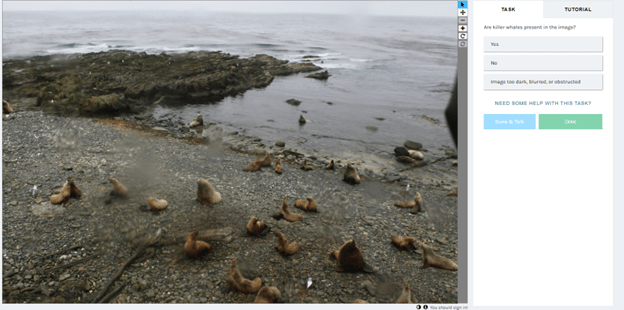
Photo from Killer Whale Count Zooniverse site
The Killer Whale Count is a collaborative project run by a trio of professionals: a Marine Science PhD student, a Research biologist, and a Conservation biologist, and supported by NOAA (National Oceanic and Atmospheric Administration) and the University of Canterbury (New Zealand).
The objective of the study is to assess the potential impact of Orca whales (Orcinus orca) – also known as Killer Whales – predation on the Stellar sea lion colony populations of the western range of the Aleutian Islands.
The research projects focuses solely on the impact of this particular threat facing the sea lion population.
The study involves sets of citizen scientists looking through almost 1 million photographs taken by remote cameras between 2016 and 2019 and identifying any sightings of Orcas. This huge dataset of photos were taken by cameras installed at various sites in the Aleutian Islands.
Click on photo to enlargeClick on photo to enlarge
Some of the cameras were installed to look over mostly land (edge of shore) to identify and monitor Stellar Sea Lion populations. These photographs also can be used to identify opportunistic images of Orcas in the nearby water.
Other remote camera boxes were placed around the sea lion populations and aimed at the water to increase the chances of capturing an image with an Orca.
The Team leading the study partnered with Zooniverse – the world’s largest and most popular platform for people-powered research (https://www.zooniverse.org/projects). It focuses on accomplishing scientific research using volunteers, enabling projects that may not have been possible, or practical, without access to unlimited volunteer citizen-scientists.
Zooniverse Project List Home Screen
Zooniverse has a wide-ranging and ever-expanding suite of available projects run by scientists and researchers from every industry and discipline, with topics across all sciences and humanities. So it’s easy to find a project for a topic you are passionate about.
With help of Zooniverse volunteers, researchers can analyze large sets of data quickly and accurately. Projects run through Zooniverse volunteers have discovered interesting discoveries and produced a large number of published research papers. Research that has had impact on the world (check out: https://www.zooniverse.org/about/publications), as well as produced many open-source sets of analyzed data future projects can rely on to boost their progress.
What’s amazing is that it can be done through a computer or your phone from anywhere and it’s easy to do it as a group, in a class, etc. Plus, as a volunteer for a specific project, you can chat with the scientist Team and other volunteers and you are kept up to date on research findings. It is easy to see the tangible results of your impact!
Once you sign up for a project you are provided a short, helpful, educational self-paced study guide that trains you on how to do the project and provides interesting contextual information.
For the Killer Whale Project, I would be given randomly selected photographs from their dataset to review. I was to find, mark and count the Orca sightings in the images. I was given specific instructions with multiple examples of what to look for and how to mark the photographs. I also had access to a field guide for killer whale identification.
Their training and FAQ sections highlighted tips and tricks and common misidentification errors. A nice social aspect of the project was the ability to “favorite” any photographs so other volunteers, and the research team, could see them.
I started with about 75 photos. The photos are given to you one at a time and you can do as many, or as few, as you would like. One day I could only look at a few. Another day I had time to look through a few dozen.
I saw seals in most of the photos but no whales at first. I could, however, see photos of other participants, and those provided by the scientific team, which showed whale sightings. It was fun to see the seals and know I was part of a team of citizen scientists making a difference.
Could the scientist and research team have used machine learning and AI (Artificial Intelligence) to do this task instead of volunteers? Yes. But it would take time to set up the testing and one of their goals is to work on a citizen science project to promote outreach, raise awareness of human impact on nature, and get others involved in helping an important endangered species.
Since I started working through the photographs, I find myself coming back to do more whenever I have down time. I’ve found it especially helpful as a way to relax after a stressful day at work or when I cannot sleep at night. Participating in the project led me to do a bit of research on Stellar Sea Lions and Killer Whales, which I enjoyed and found fascinating. And through the project I feel connected to something bigger. It’s as if, from my own little corner of the universe, I’m doing something useful for the future of this great planet.
I am eager to see the research findings when the project is complete!
I also saw many other Zooniverse projects that interested me so I have a feeling I’ll be participating in others.
If you are curious about the types of projects available through Zooniverse and want to be a citizen-scientist yourself, or with your family or through your child(ren)’s school, check out the Zooniverse project site at: https://www.zooniverse.org/projects
It’s definitely fun to look through the current projects. There are dozens of them. If you see one that interests you, drop a note in the comments below. I would love to see what interests you!
Volunteering with Lasagna Love was a rewarding experience that showed me how a simple home-cooked meal can make a meaningful difference in someone’s life. Lasagna Love is a volunteer-based organization whose mission is to feed families, spread kindness, and strengthen communities. The program connects volunteer cooks with families who may be facing financial challenges, emotional stress, illness, or other hardships. What makes this organization unique is that it focuses on kindness without judgment, ensuring that anyone who needs help can request support with dignity.
To participate, I signed up through the Lasagna Love volunteer page and was matched with a family in my area who needed a meal. Once I received the request, I planned and prepared a homemade lasagna in my kitchen. I carefully gathered the ingredients, assembled the dish, and baked it, knowing that this meal would be shared by a family who might be going through a difficult time. After the lasagna was ready, I delivered it to the family, completing the process of cooking a meal and delivering kindness.
What I enjoyed most about this experience was knowing that something I made could help bring comfort to others. Cooking is often seen as an everyday task, but this experience showed me that it can also be a powerful way to care for others. I appreciated how personal the experience felt, from preparing the meal to delivering it directly to someone in need. It reminded me that small acts of generosity can have a meaningful impact.
This experience helped me understand the importance of community support and compassion. Lasagna Love began as a small effort by one mother during the pandemic and has since grown into an international movement, proving that kindness can spread quickly when people work together. Volunteering with Lasagna Love inspired me to continue looking for ways to help others and to recognize that even a single meal can offer hope, comfort, and connection.
Want to make lasagna for others? There are opportunities all over the US and in several other countries. Check out:
The first time I purchased a book of my own I was 8 years old. My grandfather had given my brother and I $3 each as a holiday gift and my mom took us to the local Toys R Us Superstore and told us we could buy whatever we wanted with our money.
8 year old me with my brother…. and my two favorite books
Money of our own for the first time – we felt like millionaires! I spent .95 cents on “A Cricket in Times Square” and $1.75 on “A Wrinkle in Time.”
The books were a little ahead of my reading ability, but I loved them anyway. I was so proud of them!
I carried them with me everywhere and read them over and over again as soon as I could. I still have them displayed proudly on my shelf today.
Books opened a world of imagination, curiosity, learning, and adventure I am still passionate about.
Project Cicero fuels that kind of love and passion in children across the 5 Boroughs of NYC through an annual, free for teachers, massive book distribution event.
Leading up to the event, Project Cicero collects new and gently used book donations and co-host book drives run by over 100+ New York City independent, public, and parochial schools.
They also accept larger book volume donations by local organizations and have an Amazon WishList for anyone looking to donate specific books.
The books are transported to a distribution site where hundreds of student, parent, and teacher volunteers unpack and sort the books, then get them ready for display. Tens of thousands of books are collected for the event.
NYC public school teachers register to attend. At the event, the books are laid out by category and/or reader age (board books, geography, foreign language, reference, STEM, young adult fiction, etc.).
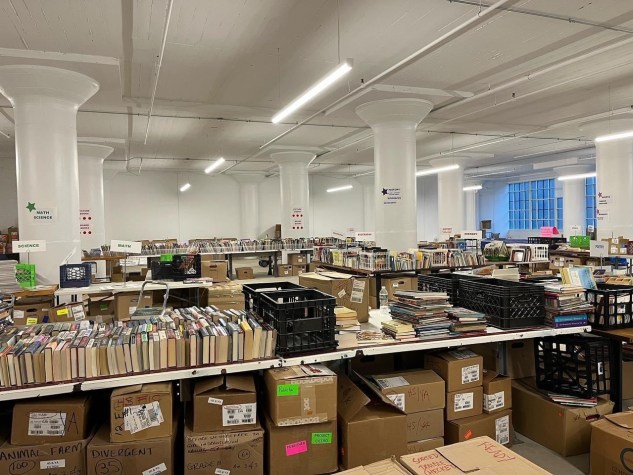
Ready for the teachers!
Teachers can spend as much time as they’d like perusing the tables and racks, and they can take as many books as they can carry back to their classrooms and schools. All the books are free.
Over 2,000 teachers registered for this year’s event, most of whom come with rolling, large-sized luggage and other wheeled containers they can completely fill with books for their students.
Teachers come with lists in hand of subjects, book titles, and genres of books they’d like to have for their classrooms/school libraries. Some of the board members of Project Cicero, and many of the volunteers, are either current or prior educators and are available to help teachers make good choices for their students.
Project Cicero is a non-profit aimed at solving inequality of resources in New York City public schools. Their event is aimed primarily at providing books to teachers at Title 1 Schools. These are schools where at least 40% of their students come from low-income families.
There are over 1800 public schools across the 5 boroughs of NYC and over 1200 of them receive Title 1 funding (1)
We learned that teachers do not only bring books back for their classroom and school libraries. They also will select books to use as rewards and incentives since many children’s families cannot afford to buy books. And they often choose books to supplement curriculum or to provide new experiences for their students.
I volunteered one of the days leading up to the event and spent my shift sorting, unpacking and repacking books.
There were boxes of donations piled high and tables were already pre-filled with books for the upcoming event.
Project Cicero encourages groups of volunteers from companies and even groups of students to come volunteer together and make a difference.
In addition, students can help organize and work at their own schools’ book drives.
Since its inception in 2001, Project Cicero has distributed over 4,000,000 new and gently-used books to tens of thousands of New York City classrooms, reaching over 1,000,000 students!
Donated books not good for use in the event (because they are too worn/damaged, or are textbooks that are too outdated, etc.) are recycled.
After the event, any books remaining that were not chosen and are of good quality are donated to local organizations for their use and distribution. They try to bring in all new stock every year.
Project Cicero was one of 33 organizations included in the NYC Materials Exchange Development Program’s inaugural study and continues to be recognized as a major re-user/recycler in New York City.
In 2020 alone, Project Cicero reused 68,308 pounds of material — saving it from landfills.
The organization is named in honor of the Roman writer, statesman, orator, and philosopher Marcus Tullius Cicero, who created extensive libraries in the first century BC.
He shared his love of literature and learning, just like Project Cicero seeks to do. Cicero is credited with the quote, “A room without books is like a body without a soul.”
Project Cicero is helping improve reading skills and reading levels, introduce students to new subject matter, increase enjoyment of reading, and inspire the love of a good book…. their goal to ensure every student has access to books is inspirational!
What was your favorite book as a child? Let me know in the comments below!
Would you like to learn more about Project Cicero?
I’ll tell you how the sun rose that morning in Tsavo National Park, Kenya – just like all other mornings for days on end. There’s nothing casual about mid-February sun in Tsavo. It rises early and immediately unleashes an inescapable tsunami of heat across the land. Then, happy with its work, the sun stands guard in a cloudless sky, both like a fierce sentinel and a tyrannous explorer, relentlessly finding every tiny crevasse and crack in the parched land. Dancing heat along the horizon shimmers and sparkles as if in great celebration of the quest.
Across these southern plains of Kenya, communities of termites are building their mounds. They excavate nutrient-rich soil from deep underground and transport it to the surface, building their structures higher and higher, reaching to the sky, seeking fruitlessly to touch any possible breeze. But there is none. Not yet. Not until the deluge of the rains come in March.
The dirt the termites excavate is packed with minerals and nutrients not available otherwise in the surrounding soil of the plains. Over time, battered by seasonal rains, wind, heat and wildlife, the mounds eventually erode and leave large patches of bare soil filled with nutrients. These patches dot the landscape like freckles across the dusty plains.
They are a perfect visiting spot for families of elephants, who are drawn to the patches for the rich nutrients and salts in the clay…. minerals the elephants need for survival.
The elephant families come and dig into the patches, scraping up the nutrient-rich soil with their feet and tusks and leaving behind an indented area. Slowly, over time, the indented clay patch becomes deeper and deeper as more elephants visit. Then it rains.
Rainy season brings with it a deluge of life-giving water and the fine, mineral-rich clay of the patches becomes sticky mud. The elephants love it – they dig in it and spray the mud on themselves and each other. They wallow in it and roll in it and splash it all over themselves. The mud coats their bodies, head to toe, keeping them cool and protecting them from sunburn and biting flies.
Each elephant family carries away up to a ton of mud with them, so the indented freckle becomes a larger indented spot, and eventually a deeper hole that continues to widen and deepen with each visit. Within a few years, what the termites started, and the elephants created, becomes a full watering hole. An oasis in the plains, full of life….
This was part of the story shared in the independent documentary film “The Elephant and the Termite”- one of 35 powerful and exhilarating documentaries shown at the 9th Annual New York Wild Film Festival.
The Elephant and the Termite won the Best Cinematography award and it was easy to see why.
The film was enchanting and stunning – silhouettes of elephants against an orange sunset, the deep greens of chameleons poised perfectly on seasonal grasses, drinking crystal clear drops of water, underwater shots and close-ups of wildlife of all types (birds, insects, mammals). It was hard to pull myself away from the film!
Me at the “paparazzi” screen
The festival ran 4 days, and I was super-excited to be chosen to volunteer for a shift on Saturday, welcoming guests and generally helping guests however and wherever possible.
There were a team of volunteers who helped check people in, provided guidance to find film showings and reception areas, answered questions, helped usher people to their seats, organized gift baskets, helped set up and break-down, and more
While films were in process the volunteers had opportunity to watch some of the films from a separate viewing area. It was inspiring and emotional to watch parts of the films!
The NY WILD Film Festival is the first annual film festival in NY to showcase a spectrum of topics that bring attention to wildlife, conservation, exploration, and the environment. It is held every March.
2023 Event Poster
More than ever, people are fascinated with the natural world and phenomenon that affects it. There is a quickly-awakening awareness of human impact on our planet and a growing feeling of urgency to live differently in order to save it.
People want to connect with our planet and understand how to do better for the natural world.
The NY WILD Film Festival provides an active platform creating excitement around crucial issues, gives a voice to critical issues, builds important partnerships with key players in exploration and conservation, highlights dedicated scientists and explorers, celebrates filmmakers, and reaches growing audiences – spreading energy around protecting our planet. Films run anywhere between 5 and 90 minutes.
There were films by filmmakers from all over the world (USA, Brazil, France, China, Mexico, Kenya, Canada and more) and that diversity of experience and perspective was truly inspiring. The festival also includes Q&A sessions with filmmakers, explorers and experts.
It was exhilarating for ticket-holders to be able to watch the films, be moved by the powerful images and storytelling of the filmmakers, and then meet the heroes protecting our planet for Q&A sessions.
There were various receptions, award presentations, and on-line auction, and even a family program for children ages 7+.
The festival presented an extraordinary opportunity to exchange ideas and effect change. Over 300 films were originally submitted, which were initially vetted by a group of pre-screeners, who chose a large number of films to go to a Final Jury for selection of the final 35.
The festival runs in partnership with The Explorers Club (the festival was held in its NYC location), the WCS (Wildlife Conservation Society), FujiFilm, Acr’teryx, Flite, and The New Yorker Documentary.
I left that day feeling that while there is much to do to save the planet, there is an extensive network of passionate, powerful, action-oriented teams of people looking to solve issues and make the world a better place for future generations! I am inspired to get more involved in making a difference and continuing to learn more about the synergistic human-wildlife-planet experience. Each of us already have impact – it’s up to us to make that impact positive or negative.
How do you celebrate the wild? What passions do you have for the planet? Leave me a comment below.
If you’re interested in learning more about the New York WILD Film Festival, to join their mailing list and to keep an eye out for tickets for next year’s festival, check out their site here: https://nywildfilmfestival.com/
This is the link to the inspiring and powerful trailer for the 2023 film festival here (you’ll be glad you watched it and I bet you can’t just watch it once): https://vimeo.com/802503624
A note about The Explorer’s Club – As hosting partner to the festival, The Explorers Club is a perfect location for the event. Founded in New York City in 1904 by a group of the world’s leading explorers of the time, the not-for-profit organization is dedicated to scientific exploration of land, sea, air, and space by supporting research and education in the physical, natural and biological sciences.
The Club’s members have been responsible for an illustrious series of famous firsts: first to the North Pole, first to the South Pole, first to the summit of Mount Everest, first to the deepest point in the ocean, first to the surface of the moon.
The building is stunning – 5 floors filled with artifacts and photos from explorations and scientific breakthroughs. You can spend hours just looking around!
You can learn more about the Explorer’s Club and their programs and public events here: https://www.explorers.org/